
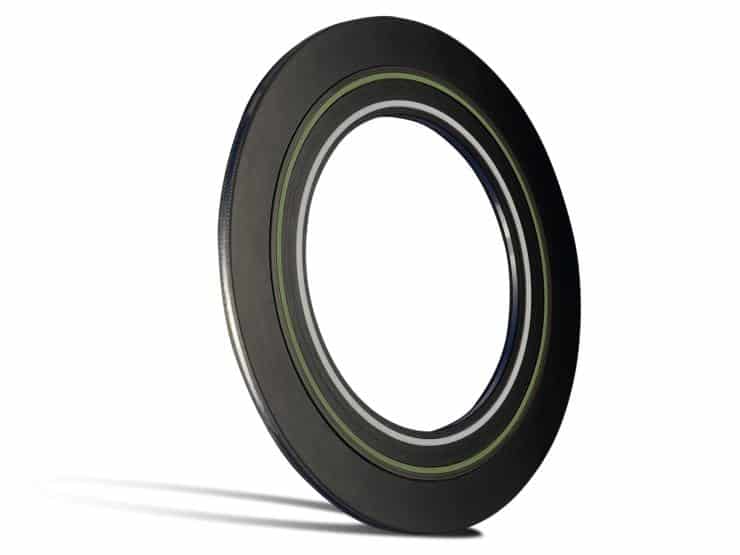
The VCFS® Fire Safe Gasket enhances the proven Pikotek® VCS® design by adding advanced fire protection through a secondary sealing element engineered to maintain an effective seal when exposed to temperatures up to 1500°F (815°C). Designed for demanding industrial applications, the VCFS fire resistant gasket delivers reliable sealing performance in aggressive operating environments while meeting the requirements of the API 6FB, 3rd Edition fire test³.
Featuring a unique pressure-activated sealing mechanism, this high-temperature gasket requires significantly less bolt load to achieve a dependable seal compared to conventional gasket technologies. Additionally, the precision-engineered E-ring functions as a secondary seal during normal operating conditions and automatically becomes the primary sealing element during fire exposure, ensuring continued sealing integrity when it is needed most.
Note: The “FS” or “Fire Safe” designation indicates only that this gasket has successfully passed the API 6FB fire test. Because every fire scenario involves unique conditions and uncontrollable variables, no additional claims regarding fire suitability or performance are implied. Engineers, operators, and end users should evaluate their specific application requirements when selecting and installing FS-style gaskets. Covered under patents 266755, 7976074, and 2271866.
Features & Benefits
- Delivers exceptional sealing reliability and electrical insulation performance for critical pipeline and flange applications.
- Engineered to withstand demanding service conditions, including high bending loads, vibration, thermal cycling, and pressure fluctuations¹.
- Provides superior performance in highly corrosive environments containing elevated levels of CO₂, H₂S, produced water, and other aggressive media.
- Offers outstanding electrical isolation properties to support effective cathodic protection systems².
- Pressure-activated sealing technology ensures dependable leak prevention and reduces costly maintenance and downtime.
- Precision-manufactured to match flange bore dimensions, protecting flange faces from corrosion, erosion, and media attack while minimizing flow turbulence at flange connections.
- GPT can match the inside diameter (ID) of virtually any flange assembly, helping reduce flow-induced corrosion, erosion, and micro-biologically influenced corrosion (MIC) commonly associated with conventional gasket designs.
- Helps prevent galvanic corrosion between dissimilar metal flanges, extending equipment life and reliability.
- Insulating kits include full-length sleeves and high-strength double washers as standard, providing maximum protection against electrical short circuits.
- High-strength laminate insulating materials resist crushing and failure caused by excessive bolt loads and over-tightening.
- Spring-energized PTFE sealing elements maintain continuous radial sealing force and groove encapsulation, eliminating cold flow and enhancing long-term performance.
- Available to suit virtually any flange standard, including ANSI, API, BS, DIN, AS, and other international specifications.
- Capable of providing an effective seal between mismatched RTJ and Raised Face flange configurations.
¹ Based on design review. For additional technical information, please contact GPT Product Engineering at gpt.engineering@gptindustries.com.
Applications
- Fire-safe flange insulation systems compatible with cathodic protection for enhanced pipeline integrity
- Electrical isolation between dissimilar metals to prevent galvanic corrosion and extend equipment life
- Wellhead flange isolation for protection of interconnected flow lines and production systems
- Reliable sealing and isolation solutions for valve flange connections
- High-performance isolation sealing for Christmas Tree flange connections
- Durable flange sealing solutions for pump connections in demanding operating environments
- Engineered isolation gaskets for compressor flange connections and critical process equipment
- Seal mismatched ring-joint (RTJ) and raised-face flanges (VCFS seals RTJ, raised-face, flat-face, and slip-on flanges)
- Eliminate fluid-trap corrosion between RTJ flanges exposed to CO₂, H₂S, and aggressive hydrocarbon media
- Reduce turbulence and flow-induced erosion between ring-joint (RTJ) flange connections
- Maintain leak-free sealing between flanges exposed to vibration, cavitation, and compressor station service conditions
Product Specifications
- Ring type joint (RTJ) flanges from 2”- 36” (50mm - 920mm)
- Raised face flanges from 1”- 36” (25mm - 920mm)
- Compressive Strength: 66,000 psi
- Dielectric Strength: 800 VPM
- Water Absorption: 0.10
- Tensile Strength: LW 40,000 psi / CW 32,000 psi
One isolating and sealing gasket, VCFS Type “F”, 0.260” thick or .308” thick, 316 stainless steel core retainer laminated on both sides with a G-10 fiber glass reinforced laminate containing a precision tapered groove to accommodate the controlled compression of a PTFE spring energized seal. Another groove shall contain a carbon steel backup ring with a proprietary isolating coating and an Inconel® E-ring coated with PTFE. Sealing element placement shall accommodate either flat, raised or RTJ face flanges. The PTFE seal shall be spring and pressure energized. The G-10 retainer shall have an 800 volts/mil dielectric strength and a minimum 66,000 psi compressive strength. The I.D. of the flange isolating gasket shall match the bore of the flange in which it is installed. Product have passed API 6FB fire testing.
Note: Electrical values are based on laboratory conditioned samples in laboratory conditions. Exposure to moisture or elevated temperature will change values.