
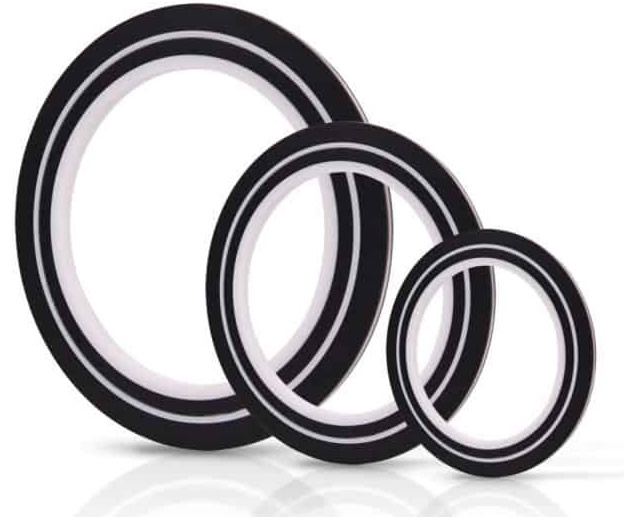
The VCS-ID® (Inside Diameter) Seal is an advanced PTFE isolation seal that incorporates a precision-machined internal PTFE sealing element into the proven VCS design platform. Its patented interlocking mechanism creates an exceptionally tight seal at the pipe bore. Additionally it provides superior resistance to internal pressure, aggressive process media, and demanding operating conditions. The interlocking feature is engineered to extend approximately 0.100 inches beyond the pipe ID prior to installation.
During installation and loading, the interlocking mechanism compresses to a final dimension that remains slightly larger than the pipe inside diameter.
Reduce Conductive Build-Up & MIC Risk
This design helps minimize cavitation within the pipeline, reduce flange face erosion, and mitigate the risk of microbiologically induced corrosion (MIC) without impacting pipeline pigging operations or flow performance.
The PTFE interlocking seal also creates a greater effective isolation distance than standard gasket designs. Traditional VCS gaskets leave the steel core exposed to process media, increasing the potential for electrically conductive bridges to form between the flange face and gasket core. This risk is especially high when conductive particles in the media accumulate as sediment within the pipeline. Because the PTFE inner seal extends the full thickness of the gasket, it completely eliminates the possibility of conductive sediment creating an electrical path between the steel core and flange face. In addition, PTFE is non-hygroscopic and does not absorb moisture, making it an ideal first line of defense for maintaining reliable electrical isolation. This innovative design helps solve common isolation failures that can occur after hydrotesting.
Patented Technology
The patented interlocking mechanism features a unique dual-locking design that securely retains the seal during handling, transportation, and installation. This dual-locking technology creates a positive mechanical lock in both radial and vertical directions, ensuring long-term seal integrity and performance.
Another key advantage of the VCS-ID seal is its ability to eliminate the need for expensive exotic metal gasket core materials. By breaking the metal-to-metal electrical path, the seal delivers effective isolation without requiring specialty alloys that often involve higher costs and extended lead times.
Because PTFE does not absorb water, installations that undergo electrical isolation testing shortly after hydrotesting are less susceptible to compromised test results caused by moisture retention. The VCS-ID seal also requires no additional bolt torque compared to standard VCS or VCFS products, allowing for simple installation using the same proven torque specifications and installation procedures. Request a Quote today.
Features & Benefits
- Superior Chemical Resistance: Perfect for aggressive process applications and high-chloride environments prone to Stress Corrosion Cracking (SCC). [1, 2]
- No Exotic Metals Required: Features a 316L stainless steel core, eliminating the need to source expensive exotic metal cores to match specialty flange materials. [1, 2]
- Electrical Isolation: Ideal for installations requiring electrical isolation testing immediately following hydro-testing. [1]
- High-Temperature Rating: Available with a G-11 carrier for extreme thermal performance up to 392°F / 200°C. [1, 2, 3]
- Smart Design: Features dual seals for superior leak prevention; nominal pipe sizes 6” and up are standard. [1, 2]
- Optimal Compression: Features an inner diameter larger than the pipe bore; under compression, it perfectly matches the bore to prevent conductive sediment build-up and flange gap issues
Applications
- Flange insulation systems for use with cathodic protection to improve corrosion control and prevent stray current flow
- Electrical isolation between dissimilar metals to prevent galvanic corrosion and extend equipment service life
- Wellhead isolation from interconnected flow lines for enhanced pipeline and asset protection
- Valve flange connections requiring reliable sealing and electrical isolation
- Christmas tree flange connections in oil and gas production applications
- Pump flange connections requiring long-term sealing performance and corrosion protection
- Compressor flange connections for demanding industrial and energy applications
- Chemical processing and corrosive media applications requiring advanced sealing and isolation solutions
- Sealing mismatched Ring Type Joint (RTJ) and Raised Face (RF) flanges with a single versatile sealing solution
- Compatible with Ring Type Joint (RTJ), Raised Face (RF), Flat Face (FF), and Slip-On flange configurations
- Eliminates fluid traps commonly associated with RTJ flanges, helping reduce the risk of stress corrosion cracking (SCC) in corrosive environments
- Provides enhanced flange sealing performance for pipeline, refining, petrochemical, offshore, and industrial processing applications
- For Slip-On flange applications, contact GPT Engineering for application-specific recommendations and technical support.
Product Specifications
One isolating and sealing gasket, VCS-ID Type “F”, 0.260” thick or .308” thick, 316 stainless steel core retainer laminated on both sides with a G-10 fiber glass reinforced laminate containing a patented, mechanically locking PTFE sealing element. The PTFE element will be concave on the I.D. to induce pressure activation. The PTFE sealing element will be approximately 0.100” larger than the bore. Sealing element placement shall accommodate either flat, raised or RTJ face flanges. The G-10 retainer shall have a 800 volts/mil dielectric strength and a minimum 65,000 psi compressive strength.
Note: Physical, mechanical, and electrical properties are obtained through testing of material samples in laboratory controlled environments. Exposure to moisture or elevated temperature will change values.